Every growing business hits the same fork in the road. The tools that got you here — a subscription app, a spreadsheet, an off-the-shelf product — start to creak. Work that should take minutes takes hours. People build little workarounds. And someone, eventually, asks the question: should we just build our own?
It's a real decision with real money attached, and the honest answer is: it depends on where your business is. Off-the-shelf software is the right call more often than software companies like to admit. But there's a point where it quietly starts costing you more than it saves — and most businesses cross that line long before they notice.
Here's how to think about it clearly.
What "off-the-shelf" really gives you
Off-the-shelf software — the ready-made apps and SaaS products you subscribe to — exists because most businesses share most of their needs. Accounting, basic CRM, email, scheduling: these are mostly solved problems, and a good ready-made tool will do them well for a fraction of what building your own would cost.
The appeal is obvious:
- Cheap to start. You pay a monthly fee and you're running today, not in three months.
- Someone else maintains it. Updates, security, and fixes aren't your problem.
- Proven. Thousands of other businesses have already shaken out the bugs.
For a lot of needs, that's exactly right. If a ₹2,000-a-month tool does the job, building a custom version would be a waste of money. We'll tell clients this plainly — not every problem deserves custom software.
Where off-the-shelf quietly starts to hurt
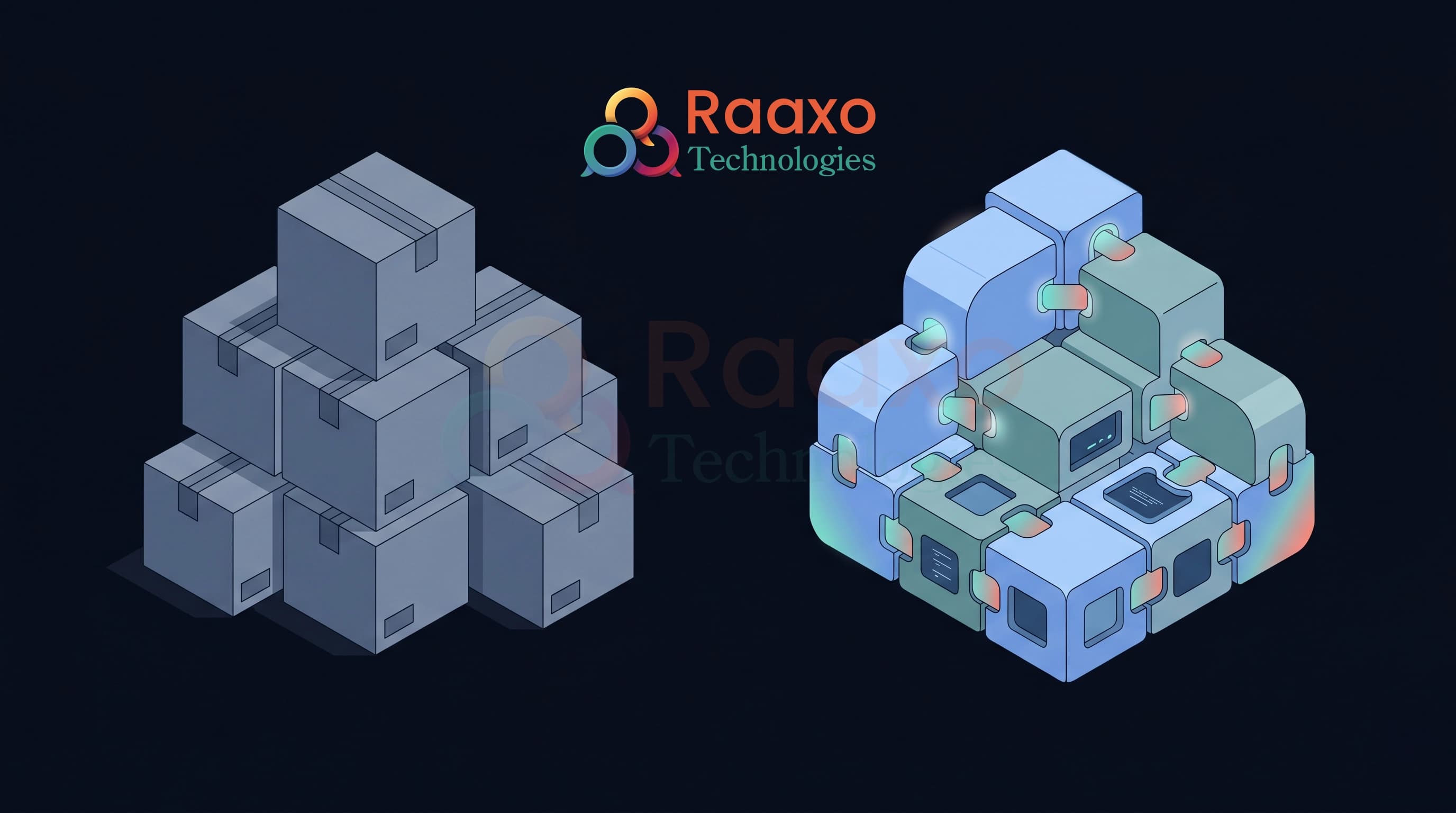
The trouble is that ready-made software is built for the average of many businesses. The closer your operation is to that average, the better it fits. The more your business has its own way of doing things — and most established businesses do — the more you end up bending your process to fit the software instead of the other way around.
The pain usually shows up like this:
- The "almost" problem. The tool does almost what you need, so your team fills the gap with manual work, side spreadsheets, and copy-paste between apps.
- Nothing talks to each other. Your CRM doesn't know about your invoicing, which doesn't know about your inventory. Someone re-enters the same data three times.
- You pay forever, per person. Per-seat fees that felt small at five people sting at fifty — and you never own anything.
- You can't change it. When you need it to work differently, you can't. You wait, or you adapt your business to its limits.
Individually these are small. Together, across a whole team, every day, they add up to a serious, invisible tax on how fast your business can move.
When custom software earns its place
Custom software flips the relationship: instead of bending your business around the tool, the tool is built around your business. That costs more upfront, and it's not the right answer for everything. But there are clear signals that you've reached the point where it pays for itself:
- Your process is your edge. If the way you operate is part of why you win, generic software actively waters it down.
- You're paying people to be the glue. When staff spend hours moving data between systems by hand, that salary is the real cost of not having the right software.
- You've outgrown the spreadsheet. Spreadsheets are brilliant until several people need them at once and one wrong cell breaks everything.
- You want to own it. Custom software is an asset you own, not a subscription you rent indefinitely.
This is the territory we work in most. We build custom software and ERP systems shaped around how a business actually runs — and we know the stakes first-hand, because we run our own operations on software we built.
The honest middle ground
Here's the part most "custom vs off-the-shelf" articles skip: it's rarely all or nothing.
The smartest approach is usually a mix — keep the ready-made tools for the commodity stuff (email, accounting), and build custom only where it genuinely moves the needle. Often the right first step isn't a giant system at all; it's solving the single most painful part of your operation with one well-built tool, then growing from there.
We've done exactly this. For a facility-management company we work with, the answer was a full ERP — because their whole operation needed to live in one place. For a tax and compliance practice, it was a system built around the specific way their industry works, with a client portal their customers actually use. Different businesses, different answers — both shaped around the real problem, not a template.
How to decide, in plain terms
Ask yourself three honest questions:
- Is the pain real and recurring? A one-off annoyance isn't worth custom software. A daily, team-wide drag is.
- Is generic software making us worse at what we're good at? If yes, that's the strongest signal of all.
- Would owning this — and shaping it exactly to us — change how we operate? If you can picture the difference clearly, it's probably time.
If you're unsure, that's normal — and it's worth a conversation before spending anything. We'd rather tell you honestly that an off-the-shelf tool is fine for now than sell you software you don't need.
If you're weighing this decision for your own business, tell us what you're working with. We'll give you a straight answer about where you actually are — and what, if anything, is worth building.