
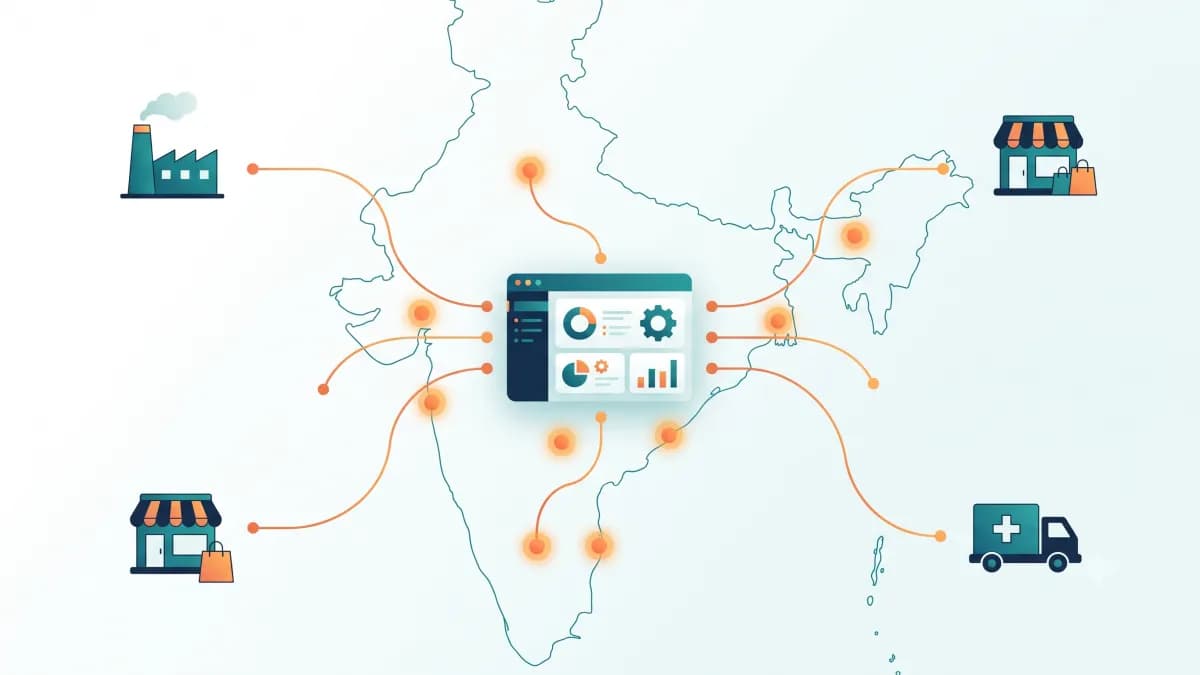
India's business landscape doesn't fit one template — and neither does its software. A textile exporter in Surat, a facility management company in Chennai, a pharma distributor in Hyderabad, and a logistics startup in Mumbai all run their businesses differently, serve different customers, and face different operational challenges. The one thing they're increasingly finding in common: off-the-shelf software doesn't fit the way they actually work.
Across India's cities and industries, the shift toward custom software India businesses are building is accelerating — and they're not doing it because it's fashionable. They're doing it because generic tools hit a ceiling.
The numbers behind the shift to custom software in India
The demand is measurable. According to Ken Research's India Custom Software Development Market report, India's custom software development market is valued at USD 1.8 billion and projected to surpass USD 10 billion by 2030. NASSCOM reports that 60% of Indian enterprises have adopted digital platforms for operations — up from 45% in 2022.
What's driving it isn't hype. It's GST complexity, India's wildly diverse business models, the mobile-first reality of Indian commerce, and the scale at which Indian SMBs now operate. The shift isn't happening in spite of India's complexity — it's happening because of it. Generic software was built for simpler, more homogeneous markets. A Coimbatore pump manufacturer and a Kochi spice exporter don't share the same workflows, tax patterns, or customer rhythms — and no single SaaS product was designed around both.
Chennai and Tamil Nadu: where IT services meet manufacturing
Chennai sits at the centre of this story for us — and for a large part of South India's industrial economy. According to Wisemonk's India Investment Intelligence 2026 report, Chennai has the most established IT services infrastructure among Indian cities. But Chennai's economy is deeper than IT corridors. Auto components feeding the Hyundai and Ford supply chains, manufacturing plants, facility management companies running sites across Tamil Nadu, healthcare providers, and education institutions all operate here — and many of them have outgrown spreadsheets and rented tools.
A facility management company in Chennai managing 50+ client sites can't run on a generic HR app. They need a system that tracks field officers, manages site-wise billing, handles GST-compliant invoicing, and gives management real-time visibility. That's exactly the kind of problem ERP development in Chennai is built to solve — software shaped around how the business already works, not the other way around.
Coimbatore, Tamil Nadu's second city, is a manufacturing powerhouse — pumps, motors, textiles, engineering goods — and one of the fastest-growing tech-adoption markets in the state after Chennai. SMEs there are adopting custom ERP for multi-product inventory, production planning, and GST returns without needing a full finance department to hold everything together. The same pattern shows up in web development in Chennai projects that connect those systems to customer portals, dealer dashboards, and mobile-first interfaces.
Mumbai and Pune: trading, finance, and manufacturing at scale
Mumbai leads fintech and payments in India's startup ecosystem (Growth List's India Startup Ecosystem 2026 data), but its older economic engine — commodities trading, textiles, FMCG distribution, real estate, logistics — is where custom software quietly earns its keep. Trading businesses deal with multi-party billing, credit management, and payment reconciliation that generic accounting software handles poorly at volume.
Custom software here often means: real-time stock visibility across multiple godowns, automated GST invoicing, WhatsApp-integrated order confirmations, and credit limit alerts that stop problems before they become write-offs.
Pune's auto manufacturing ecosystem — suppliers, tier-2 vendors, tooling companies — runs on tight production schedules and quality documentation. Job card management, supplier quality tracking, and delivery scheduling are replacing Excel at companies that can no longer afford the manual overhead. Wisemonk 2026 also flags Pune (alongside Hyderabad) as among India's strongest markets for full-stack and product engineering talent — which is one reason these cities absorb custom builds so naturally.
Bangalore, Hyderabad, and the tech-forward cities
Bangalore dominates B2B SaaS and enterprise software (Growth List 2026) and leads India in AI/ML talent and GCC density (Wisemonk 2026). Even here, businesses build custom when product-market fit demands it. A healthcare startup in Bangalore building a diagnostics platform needs appointment scheduling, lab report generation, and insurance claim workflows that no off-the-shelf product handles cleanly — so they build what the market requires.
Hyderabad's pharma and biotech sector runs on batch tracking, regulatory compliance, and export documentation. Generic ERP systems often require expensive, fragile customisation for those workflows. A purpose-built system handles them cleanly from day one — which is why a pharma distributor in Hyderabad is a classic candidate for custom software India teams actually understand, not just install.
Delhi/NCR, Ahmedabad, Surat, and the trading heartland
Delhi/NCR — Gurgaon and Noida included — dominates BFSI technology work (Wisemonk 2026) and is strongest in edtech, logistics, and govtech (Growth List 2026). Logistics and distribution businesses here face route optimisation, multi-city delivery tracking, and GST e-way bill generation at a scale that exposes the limits of generic software quickly.
In Gujarat — Ahmedabad and Surat especially — textile and diamond traders deal with consignment tracking, foreign currency billing, and industry-specific accounting that standard tools simply don't model. Custom software here isn't a luxury. It's how businesses that operate at serious volume maintain accuracy without armies of data-entry staff.
Kolkata's trading, jute, steel, and logistics firms face a similar pattern: long supply chains, multi-party settlements, and operational complexity that generic tools flatten into workarounds.
Kochi, Jaipur, and the emerging markets
Tier-2 cities like Coimbatore, Jaipur, and Ahmedabad are among India's fastest-growing markets for tech adoption, with 25–30% lower operating costs according to Wisemonk 2026 — which makes custom software more accessible for SMEs that previously assumed it was only for metros.
Kochi's logistics and commodities trading businesses — spices, seafood, cashews — deal with international shipments, quality certification, and multi-currency billing. Jaipur's gems and handicrafts exporters need systems that track artisan production, manage export documentation, and handle buyer-specific pricing across international markets.
These aren't businesses in "emerging technology" markets. They're businesses in markets where generic software was never designed with their trade in mind.
What these businesses have in common
Despite being in different cities, industries, and scales, the businesses making the shift to custom software share a pattern:
- They've hit the ceiling of generic tools
- They're operating at a scale where manual workarounds cost real money
- They have a distinctive operational core that off-the-shelf software never modelled
The city matters less than the business stage and the complexity of what they do. We've written about that decision more directly in custom software vs off-the-shelf and why every industry needs custom ERP. When the pieces don't connect — website, software, operations — growth stalls for the same reasons we covered in why your business isn't growing online.
What Raaxo builds, and where
Raaxo Technologies is based in Chennai and works remotely with businesses across India — from Tamil Nadu manufacturers to Mumbai trading companies to Bangalore startups. We don't have offices in every city, and we don't pretend to.
What we have is years of building production systems for businesses that needed software to fit the way they actually work — not the other way around. Whether that's custom software and ERP, web platforms, or the operational systems behind them, the city you're in matters less than the problem you're trying to solve.
If your business is hitting the ceiling of generic software, tell us what you're working with. We'll give you a straight answer about whether custom is worth it — or whether an off-the-shelf tool is still the right call.
Frequently asked questions
Which Indian cities have the highest demand for custom software?
Bangalore, Mumbai, Delhi-NCR, Hyderabad, Pune, and Chennai lead in volume. Demand is growing fastest in Tier-2 cities like Coimbatore, Ahmedabad, Jaipur, and Kochi as SMEs in these markets outgrow generic tools.
Why do Indian businesses need custom software instead of off-the-shelf tools?
India's business environment is highly diverse — GST complexity, COD, multi-language requirements, industry-specific workflows, and the scale of Indian SME operations all create needs that generic software (built for simpler, more homogeneous markets) doesn't handle well.
Can a Chennai-based software company build for businesses in other Indian cities?
Yes. Raaxo Technologies is based in Chennai and builds custom software for businesses across India remotely. The city matters less than understanding the business — which we do through structured discovery before writing a line of code.
What types of Indian businesses benefit most from custom software?
Businesses with distinctive operational cores: manufacturers with complex inventory, trading companies with multi-party billing, service businesses with field operations, and any business doing serious volume where manual workarounds are costing real money.
How does custom software handle India-specific requirements like GST?
Custom software can be built to handle GST from the ground up — correct invoice formats, HSN codes, multi-state tax handling, GST returns, and e-way bills — rather than relying on plugins that often conflict or break during GST rule changes.
The bottom line
Custom software India businesses are adopting isn't a metro-only story. From Chennai's industrial base to Coimbatore's factories, Mumbai's trading floors, Hyderabad's pharma corridors, and exporters in Surat, Jaipur, and Kochi — the pattern is the same. When generic tools stop fitting, the businesses that grow are the ones that build around how they actually operate.
If your business is in Chennai, Coimbatore, Mumbai, Bangalore, or anywhere across India — and you're hitting that ceiling — that's the conversation worth having.
Raaxo Technologies builds custom software, ERP, and web platforms for businesses across India — from our base in Chennai, working remotely with clients from Kochi to Kolkata. Tell us about your business.