
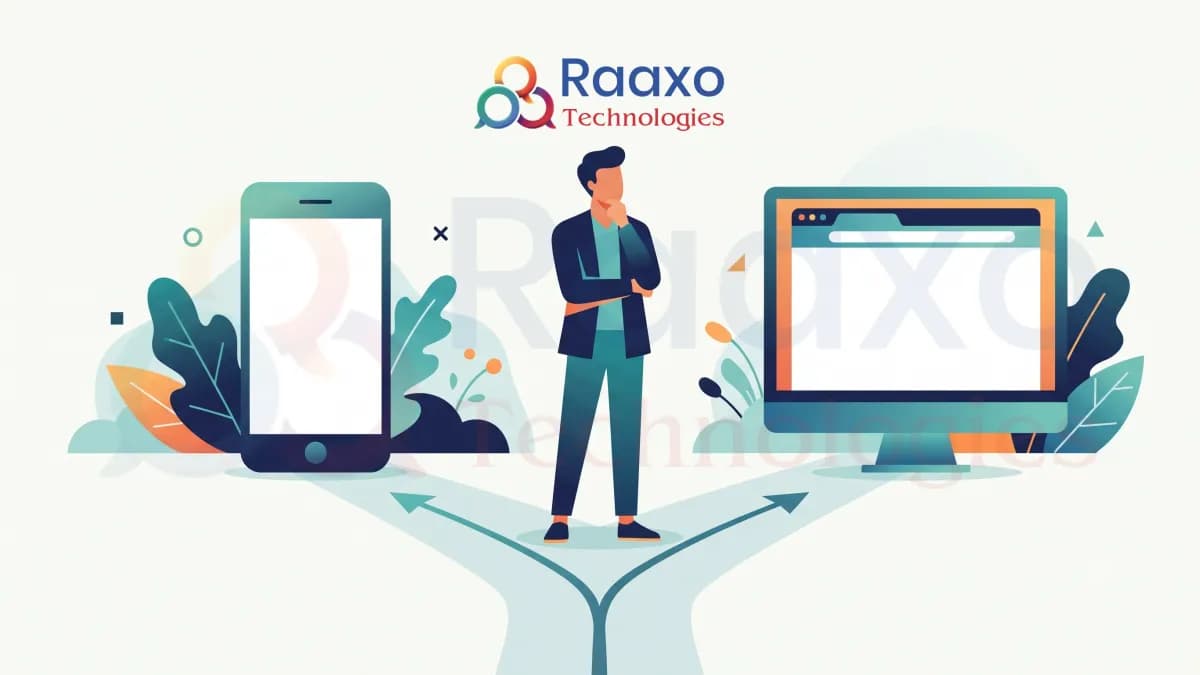
Does my business need a mobile app? Every agency pitching you will say yes — often before they've asked what your business actually does. The honest answer is: it depends. And for many Indian SMBs, "not yet" is the right call.
That's not a reason to feel behind. India is among the world's largest app download markets, and Statista puts Android at over 95% of the smartphone market here — so mobile matters enormously. It just doesn't automatically mean your business needs its own app today. Sometimes a fast, well-built website will serve you better right now. This guide gives you a clear way to decide — without the sales pitch.
First, understand what an app actually does (and doesn't do)
Here's the distinction most app pitches skip: apps are retention tools, not discovery tools.
People don't find new businesses by browsing the app store. They search on Google, ask for recommendations on WhatsApp, see something on Instagram — and land on a website. Search drives acquisition. Websites convert first-time interest into a call, a form, an enquiry.
An app's job starts after someone already knows and trusts you. It makes repeat interactions faster: reorder, book again, track a job, check status, earn loyalty points. If you don't yet have a base of repeat customers, an app has almost nobody to serve — no matter how polished it looks in the store.
Websites dominate discovery. Apps dominate retention among people who already chose you. Mix those up and you'll spend heavily on something that can't do the job you're asking of it.
The three questions that actually determine if you need an app
Forget generic "digital transformation" slides. Three questions cut through the noise.
1. Do your customers interact with your business frequently?
Ideally multiple times a month. Food orders, daily field reports, weekly pharmacy runs, regular service bookings — these rhythms justify an app.
If customers contact you once or twice — a one-time renovation, an annual audit, a single large purchase — they'll download your app, use it once, and forget it exists. That's not retention. That's an expensive shortcut to the uninstall screen.
2. Is there something a phone can do that a website can't?
Push notifications for order status. GPS for field check-ins. Camera access for geotagged inspection photos. Offline use when connectivity drops. Loyalty mechanics for repeat buyers. Fast, native workflows for staff on the move.
If your customers only need to find you, read about you, and submit an enquiry, a mobile-optimised website does that job — and shows up in search, which an app doesn't.
3. Have you already validated demand?
Do you have real, repeat customers who would benefit from an app and actually use it? An app built before demand is validated is one of the most expensive experiments a small business can run — development, maintenance, app store compliance, and the opportunity cost of not fixing the website first.
If all three answers are yes: an app is worth serious consideration.
If one or two are no: build the website first. Get discovery and conversion right. Build the repeat base. Revisit the app question when the use case is obvious — not when a vendor needs a project to sell.
The honest cost picture
We're not going to quote you a price — figures vary too much by scope, platform, and quality, and they date quickly. But the structure of the cost is worth understanding.
A well-built mobile app costs significantly more than a website — in initial development, in ongoing maintenance (OS updates, app store policy changes, bug fixes on real devices), and in time. It's not a one-time launch like a brochure site. It's an ongoing commitment.
Android's dominance in India simplifies one decision: for most consumer-facing apps here, Android comes first. That doesn't make it cheap — it means you're not spreading budget across two platforms on day one unless you genuinely need both.
The question isn't can I afford to build an app? It's will the return from repeat, frequent use justify the ongoing cost? If the three questions above aren't clearly yes, the honest answer is usually: not yet.
The sequence that smart Indian businesses follow
The pattern we see work — and the one we'd recommend by default:
Phase 1: Build a fast, mobile-optimised website. Discovery via search, first conversion, trust, clarity. This is where almost every business should start. We covered why that owned hub matters in does your business still need a website — the logic applies here too.
Phase 2: Drive traffic, validate demand, build a repeat customer base. Learn what people actually use, how often they come back, what they'd want on their phone if you offered it.
Phase 3: Launch a mobile app for loyal, frequent users — retention and deeper engagement when the use case is proven.
That's not slow. It's how you avoid burning development budget on an app nobody downloads. Good web development first; app when earned. Same honest ethos we apply in custom software versus off-the-shelf: right tool, right stage — not the biggest tool available.
When an app genuinely earns its place
When all three questions are clearly yes, the use cases speak for themselves:
- Food delivery or ordering — frequent, phone-native, push updates on order status
- Field staff management — GPS, camera, offline, on-the-go tasks (more on this below)
- Loyalty and repeat retail — supermarkets, pharmacies, restaurant chains with regular buyers
- On-demand services — booking, tracking, real-time updates
- Internal tools for field teams — route planning, job sheets, photo capture on site
Notice what's not on that list: most consulting firms, one-time service providers, many B2B businesses still finding fit, early-stage startups guessing at product-market fit. An app won't fix discovery for those — a clear website and consistent follow-up will.
When the case is real, we're the team that builds it — mobile apps shaped around the workflow, not a template with your logo pasted on.
We built one — here's what the decision actually looked like
We should be honest about our own experience, because it's the test we apply to client conversations too.
We built a production mobile app for a facility-management business — real field officers, real client sites, real daily operations. Staff needed to mark attendance on location, capture inspection photos, log issues, and submit daily reports — from a phone, on the go, sometimes without reliable internet.
A mobile website couldn't handle that job well enough. Offline use mattered. Camera access for geotagged photos mattered. Speed and simplicity in the middle of a working day mattered — not a browser tab that reloads when the connection drops.
The moment we realised "a website can't do this well enough" was the moment the app was justified. Not because apps are fashionable. Because the use case genuinely required phone-native capability and repeat daily use by the same people.
That's the bar. Not "should we have an app because competitors do?" But "is there a job here that only an app does well enough for users who come back constantly?"
The middle ground worth knowing about: PWAs
A Progressive Web App (PWA) is a website that behaves more like an app — installable from the browser, can send push notifications in supported browsers, works offline to a degree.
For businesses that want some app-like functionality without full native development and app store overhead, a PWA is a genuine middle ground. It's not right for every use case — deep native camera workflows, complex offline sync, and app store presence aren't fully replaced — but for many SMBs it's worth exploring before committing to a full build.
If you're unsure whether you need native, web, or something in between, that's a conversation worth having before you spend anything. Get in touch — we'll tell you straight.
Frequently asked questions
Does my small business need a mobile app in India?
Only if your customers interact with you frequently and there's a genuine use case a phone enables — push notifications, GPS, camera, offline use, repeat purchase mechanics. If not, a fast mobile-optimised website usually delivers better return for the money and actually helps people find you.
What's the difference between a mobile app and a mobile website?
A mobile website is accessed via a browser and is discoverable through search. A mobile app is installed from an app store and serves repeat users with deeper, phone-native functionality. Most businesses need the website first; the app comes when retention — not discovery — is the problem to solve.
When should I build a mobile app for my business?
When you have a validated base of repeat customers, a genuine use case that needs phone-native features, and budget for ongoing maintenance — not just the initial build. Building before that usually means an empty app and a neglected website.
Is Android or iOS more important for Indian businesses?
Android, by a large margin. Statista puts Android at over 95% of India's smartphone market. For most Indian-facing consumer apps, Android is the sensible priority unless your audience is specifically iOS-heavy.
What is a PWA and is it right for my business?
A Progressive Web App is a website that can be installed and behaves like a lightweight app — useful for some push and offline needs without full native cost. It's a cost-effective middle ground for the right use case, but it doesn't replace a native app when you need deep device features or complex offline workflows.
The bottom line
Does my business need a mobile app? Sometimes yes — when repeat use is frequent, the phone enables something a website can't, and demand is already proven.
Often not yet — and that's a smart answer, not a failure. Fix discovery and conversion with a website built for how India actually browses: mobile-first, fast on budget phones, findable in search. Build the app when loyal users are asking for an easier way to come back.
If you're genuinely unsure whether you need an app, a website upgrade, or something in between, talk to us before spending anything. We'd rather point you at a website today than sell you an app you don't need yet.
Raaxo Technologies builds mobile apps, web apps, and websites for businesses across India — and we'll tell you honestly which one your business actually needs right now. Talk to us.