
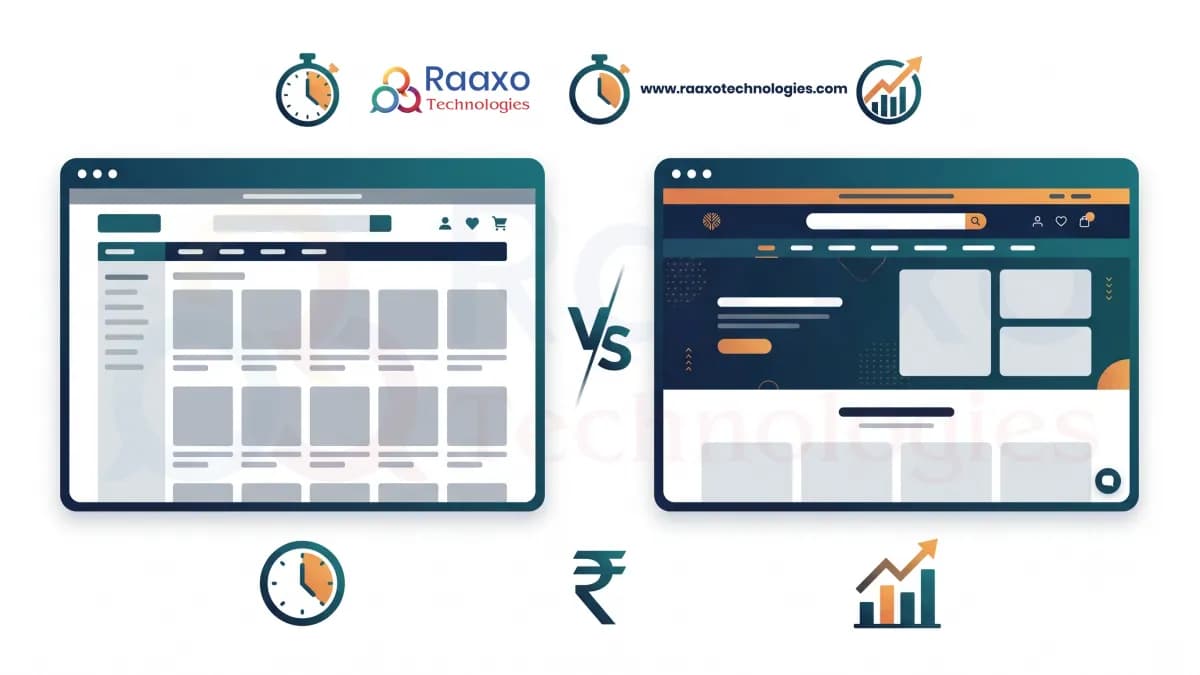
Someone is selling you a complete online store for ₹15,000 using a readymade template. Someone else is quoting ₹15 lakhs for a custom-built e-commerce platform. Both insist they're the right choice for your business. The honest answer — for ecommerce template vs custom development India buyers — is that they might both be right. For different businesses. At different stages.
This guide cuts through the sales pitch on both sides. Templates have real advantages. Custom development has real advantages. The question isn't "which is better?" It's which fits where your business is now, and where it's going — especially if you sell in India, where GST, COD, UPI, WhatsApp, and mobile-first shopping change what "good enough" means.
What "readymade template" actually means (and what it doesn't)
A readymade template — a Shopify theme, a WooCommerce theme, or a packaged store like OpenCart or Magento Community — gives you a pre-built storefront. You add products, upload a logo, tweak colours, and open for business. WordPress powers over 43% of all websites globally; most online stores still start this way for a reason.
What you get is a known structure: product pages, cart, checkout, basic SEO fields, email notifications. You're not inventing e-commerce from scratch. What you don't get is a blank canvas. You're working inside someone else's design decisions, within what the platform supports or what plugins claim to add. Going beyond that "intended" model often costs more than the original setup promised — sometimes approaching custom work, still on a foundation you don't fully control.
The real pros of a readymade template
Templates deserve a fair hearing. Ignoring their strengths is how vendors lose trust.
Speed to market. You can be live in days or weeks, not months. If you're testing whether anyone will buy, that speed matters more than a perfect architecture.
Lower upfront cost. Platform fees and a theme are far cheaper than custom development. For early-stage cash flow, that gap is real.
Proven, tested code. Shopify and WooCommerce power millions of stores. The core checkout, cart, and product flows are battle-tested.
Built-in features. Catalog management, basic SEO, order emails, inventory basics — you don't rebuild those from zero.
When a template is clearly the right call: validating a new product idea; a small catalog (under 100 products); a side business; or a shop that genuinely fits a standard product model with no exotic checkout or tax rules. Starting here is not a failure. It's how many Indian D2C brands begin.
The real cons of a readymade template (especially in India)
Where templates struggle hardest is often where Indian stores live day to day.
You look like everyone else. Thousands of stores share the same themes. Differentiation gets thin when buyers compare three competitors who all feel like variations of the same checkout.
GST compliance gaps. Basic GST is usually covered. Multi-state tax slabs, HSN codes, GST-compliant invoices, returns/credit notes, and GST reports often need plugins that conflict, cost extra, or fall short the moment your operations span more than one state.
Payment gateway friction. Razorpay, PayU, CCAvenue, Cashfree are supported on most platforms — but transaction fees stack at scale, and cash-on-delivery (still significant in India) is often bolted on awkwardly. UPI may work in theory and fail in edge cases that cost you confidence at the pay button.
Mobile performance varies wildly. Over 75% of Indian e-commerce traffic is mobile. Themes that look fine on a desktop designer’s MacBook can crawl on budget Android phones and patchy networks — and that kills conversion. Page speed isn't optional; we've covered why in why your business website needs to load fast.
Plugin conflicts. WooCommerce stores especially accumulate plugins. Each adds weight, risk, and update collisions. The store that "just needs one more plugin" often becomes the store that breaks after an update.
You don't own the platform. Pricing changes, plugin sunset, API restrictions — you're renting someone else's rules.
Scaling costs. Platform fees, transaction fees, and plugins can start around ₹1,500–₹8,000/month, then climb — and you still own nothing. What felt like ₹2,000/month at launch can feel like ₹15,000/month at volume without a single owned line of code.
Custom integrations get expensive on top. Syncing ERP, warehouse systems, or a logistics partner cleanly is rarely what a template plugin was built for. You pay twice: once for the template, again for workarounds.
What custom e-commerce development actually gives you
Custom isn't "fancier themes." It's buying software shaped around how you sell.
Built for your model. Your variants, pricing rules, delivery zones, and checkout flow — not a generic catalog you bend yourself around.
Full GST control. Custom invoicing, HSN handling, multi-state tax, formats that match how you actually file — without fighting three plugins at once.
Indian payments and logistics done properly. Razorpay and UPI flows, COD rules that mirror your risk policy, WhatsApp order updates customers already expect, Shiprocket/Delhivery/BlueDart integrations that don't drop events at volume.
Performance you control. No theme bloat, no mystery plugin tax. You decide what ships to the phone. That matters for ranking and for turning visitors into leads or orders.
You own it. No platform rent, no transaction cut to the storefront software, no plugin subscription staircase. The code is yours.
Built to scale. Catalog growth, traffic spikes, and operational complexity become design problems — not platform ceilings.
That's what e-commerce development means when it's done seriously: a store that matches how Indian customers buy and how your operations run, not a theme with your logo.
Ecommerce template vs custom development India: the 3–5 year cost picture
The smart comparison isn't launch day. It's three to five years — because that's when platform rent and conversion leaks show up as real money.
Template / platform approach (typical)
- Setup: ₹15,000–₹1,50,000 (theme + config + light customisation)
- Platform fees: ₹1,500–₹8,000/month ongoing
- Plugins: ₹500–₹5,000/month for essentials
- Transaction fees: often 1–2% of GMV on many platforms
- Later customisation when you outgrow the theme: ₹50,000–₹3,00,000
- Year 3 total: often ₹6L–₹15L spent — with no owned asset
Custom development (2026 India market rates)
- Build: ₹12L–₹25L+
- Maintenance: ₹1L–₹3L/year
- No platform fees or storefront transaction percentage to a SaaS landlord
- You own the code
- Year 3 total: roughly ₹15L–₹31L — owning a platform built for you
Where the numbers tip
For a business doing ₹50L+ annual GMV, template transaction fees and platform costs often approach or exceed the cost of custom within 3–4 years — without ever owning the storefront. That's the inflection most people miss when they only compare the ₹15,000 launch against the ₹15L build.
Conversion compounds the math. Businesses moving from template to custom e-commerce report conversion improvements of 20–40%, according to 2026 case studies cited by Indian e-commerce development agencies. One Indian B2C brand moved from 2% to 4.2% conversion after switching. At ₹50L GMV, that kind of lift can pay for the custom build within a year — before you count GST headaches avoided and logistics that actually sync.
Upfront cheap and long-term expensive are not the same decision. Same theme as custom software vs off-the-shelf: right tool for the stage, measured honestly over time.
Ecommerce template vs custom development India: the country-specific factors
India isn't a Western template market with a different currency. A few realities decide outcomes:
GST complexity. Multi-state stock, HSN codes, returns, and compliance reporting aren't "nice plugins." They're table stakes for serious sellers. Templates cover basic GST; nuance usually needs custom or fragile specialist stacks.
COD still matters. If your checkout treats COD as an afterthought, you lose sales in markets where trust still travels with cash.
Mobile-first is non-negotiable. Over 75% of Indian e-commerce traffic is mobile. Theme quality is uneven; custom lets you design for the devices and networks your buyers actually use.
UPI and regional payment habits. Buyers expect UPI to feel native, not like a translated overseas checkout.
WhatsApp for order communication. Updates, queries, delivery nags — customers already live there. Clean WhatsApp integration beats another email nobody opens.
Regional language support for non-metro markets where English-only storefronts quietly shrink the funnel.
Logistics at volume. Shiprocket, Delhivery, BlueDart integrations that stay reliable under load — plugins start, custom stays clean when order volume rises.
Templates cover basics. Custom covers the nuances that convert Indian customers and keep operations sane.
The decision framework: which is right for you?
Use this as a checklist against your actual business — not against a vendor pitch.
Choose a template / platform if:
- You're validating a new product or brand and need to test demand first
- Catalog is small (under 100–200 products) and fits a standard catalog model
- Budget is genuinely tight and you're early stage
- You sell standard products without exotic checkout, pricing, or tax rules
- Speed to market matters more than differentiation right now
Choose custom development if:
- You're at ₹50L+ annual GMV and fees are becoming material
- You need GST invoicing, HSN management, or multi-state tax beyond what plugins handle cleanly
- Catalog, pricing, or checkout doesn't fit the standard template model
- You need clean ERP, logistics, or CRM integration
- Brand differentiation is strategic — you can't look like three competitors using the same theme
- You've already hit the template ceiling (speed, plugins, fees, or broken workflows)
The middle path
Many Indian businesses start on a well-configured WooCommerce or Shopify store, grow to ₹30–₹50L GMV, then move to custom. That sequence is sensible. You're not wasting money building custom before you know what the business needs.
The mistake is staying on the template past the point where rent, fees, friction, and conversion leaks cost more than a custom build. Reassess when GMV climbs, GST ops get complex, or every "small customisation" becomes another plugin and another delay.
What to watch out for (red flags on both sides)
Template red flags: quotes that ignore platform fees, transaction fees, and plugins; a "₹15,000 full e-commerce website" that's a theme install with your logo; promises of unlimited scale from a cheap shared-host clone.
Custom red flags: an agency that recommends custom without asking about catalog size, GMV, tax/GST needs, or budget; a lump-sum quote with no feature-by-feature scope; silence on post-launch support and maintenance. Same honesty test we apply to web development and software decisions generally: if they don't ask sharp questions, they aren't scoping your store — they're selling a package.
Frequently asked questions
Is a readymade e-commerce template good enough for an Indian business?
For early-stage validation, small catalogs, or standard product businesses — yes. Once you're doing ₹50L+ GMV, need complex GST handling, or require integrations beyond plugins, custom development typically delivers better long-term value.
How much does custom e-commerce development cost in India?
A custom platform typically costs ₹12L–₹25L+ to build (2026 India market rates), plus ₹1L–₹3L per year maintenance. Measured against 3–5 years of platform fees, transaction percentages, and plugins, many growing businesses find custom cost-effective over time — and they own the result.
Can I start with a template and move to custom later?
Yes — and many Indian businesses do. Validate on WooCommerce or Shopify, grow toward ₹30–₹50L GMV, then invest in custom. The mistake is waiting too long after the template starts costing more than it saves.
Which is better for SEO — a template or a custom e-commerce site?
Custom gives you control over page speed, structured data, URL structure, and technical SEO. Platforms have SEO features with limits by theme and stack. For competitive categories, where speed and conversion both matter, custom usually wins — if it's built and maintained properly.
Do Indian e-commerce websites need custom GST handling?
Basic GST (simple rate, simple invoicing) is manageable on most platforms. Multi-state operations, complex HSN management, GST-compliant invoice formats, and automated GST reports typically need custom development — or specialist plugins that often conflict.
The bottom line
Ecommerce template vs custom development India isn't a moral contest. Templates win when you need speed, low risk, and proof of demand. Custom wins when operations, GST, payments, logistics, mobile performance, and ownership become the bottleneck — and when three to five years of fees and lost conversion outweigh a proper build.
Decide against your stage and your path, not against whoever emailed the flashiest quote. If you want an honest read of where you sit on that spectrum — template, custom, or middle path — start with a real conversation about your catalog, GMV, and constraints.
Raaxo Technologies builds custom e-commerce platforms for businesses across India — scoped around your catalog, your customers, and your GST requirements, not a generic template. Talk to us about your online store.