
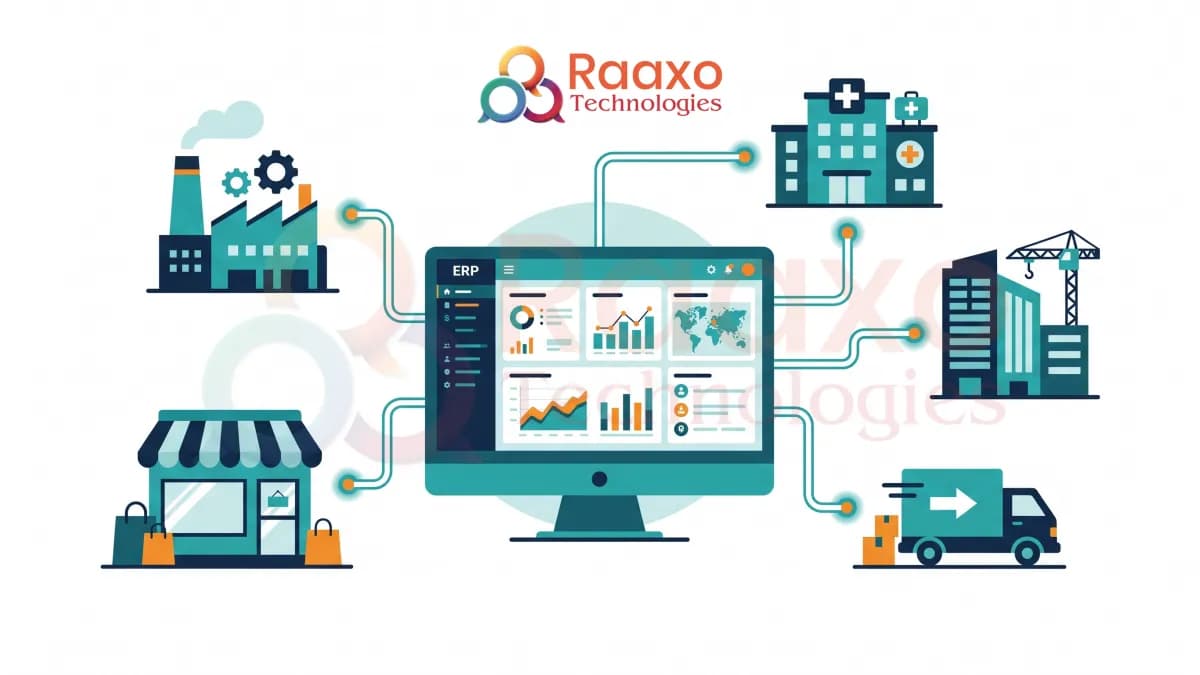
Most businesses don't set out to buy an ERP. They reach for one the day the spreadsheets stop coping — when inventory, payroll, invoices, and field operations are scattered across a dozen files and three people's inboxes, and no one can answer a simple question like "what did we actually spend last month?" without a half-day of reconciliation.
The instinct at that point is to buy a ready-made ERP and be done with it. Sometimes that works. But far more often, businesses discover the same uncomfortable truth a few months in: the software was built for an industry, just not theirs — and definitely not for the way they actually run. That gap is exactly why custom ERP software has stopped being an enterprise luxury and become a practical decision for growing businesses across nearly every industry.
The data already says it: most businesses can't use ERP "out of the box"
If off-the-shelf ERP really fit most companies, very few would change it. The opposite is true. Industry data from Oracle NetSuite shows that roughly two out of three organizations customize their ERP — about 45% make moderate customizations and around 21% heavily modify the system to match how they work. In other words, the "ready-made" system is rarely used as-is; companies spend additional time and money bending it toward a fit it didn't ship with.
And this isn't just a big-business concern. More than 80% of small and medium enterprises with annual revenue under $50 million now rely on ERP systems — adoption among smaller, faster-moving businesses is exactly where the growth is. The question for most companies is no longer whether to run on an ERP, but whether to keep paying to retrofit a generic one or build one that fits from day one.
Off-the-shelf ERP is built for the average. Your business isn't average.
A packaged ERP has to sell to thousands of companies, so it's designed around a generic, lowest-common-denominator workflow. To make it fit your business, you do one of two things: bend your processes to match the software, or pay for endless customization and add-on modules until the "ready-made" system quietly costs more than something built for you in the first place.
Either way, you end up working for the software instead of the other way around. Fields you don't need clutter every screen. The one report you actually care about doesn't exist. The approval flow that matters to your business gets tracked manually on the side. None of this shows up in the sales demo — it shows up six months later, in daily friction. Custom ERP flips that relationship: the system is shaped around how your business already works, not the other way around. (If you're still weighing the broader trade-off, our guide on custom software vs off-the-shelf breaks it down in detail.)
The ERP need is different in every industry
The clearest argument for custom ERP is simply this: no two industries run the same way, and a generic system pretends they do. A few examples:
Facility management lives or dies on field operations — staff marking attendance at client sites, daily reports, issue logging, inspections, and site-wise billing. A generic ERP has no concept of "site," "field officer," or "shift," so all of that gets bolted on awkwardly or tracked outside the system entirely.
Manufacturing needs bills of materials, production planning, and shop-floor tracking tied tightly to inventory and procurement. A retail-oriented ERP simply doesn't model any of that.
Distribution and wholesale revolve around fast-moving stock, batch and expiry tracking, and multi-location inventory — where a small error in numbering or stock logic compounds into real money lost.
Healthcare and diagnostics carry patient records, appointment flows, and compliance requirements that a standard sales-and-inventory ERP was never designed to hold.
Retail and services depend on point-of-sale, fast reconciliation, and customer history that has to stay accurate across every outlet in real time.
Professional and tax practices run on a leads-to-clients-to-invoices pipeline with recurring compliance deadlines — closer to a specialized CRM than a traditional ERP.
The pattern is consistent: the core of every business is the part that's unique to its industry, and that core is exactly what off-the-shelf ERP handles worst. This is also why industry-specific ERP development tends to deliver more value than a heavily customized generic platform — you're building on the unique part instead of fighting the software to reach it.
Signs your business has outgrown generic software
You don't need a consultant to tell you it's time. The signals are usually obvious from the inside:
- Your team maintains spreadsheets alongside the software to track the things the software can't.
- Reports take hours to assemble because the data lives in three different places.
- New staff take weeks to learn the workarounds, not the system.
- You've paid for modules you don't use and still can't do the one thing you need.
- Growth makes everything slower instead of faster, because every new site, client, or product multiplies the manual work.
When the tools meant to create order start creating overhead, the cost of not having a system that fits has quietly overtaken the cost of building one.
What custom ERP actually gives you
A well-built custom ERP isn't just "the same software with your logo on it." Done properly, it delivers things generic systems structurally can't — and the measurable payoff is well documented. Businesses that implement ERP effectively report meaningful gains: studies summarized in recent ERP research show around 74% of companies seeing increased productivity and roughly 91% reporting optimized inventory levels after implementation. The difference with a custom build is that those gains are aimed precisely at your bottlenecks rather than a generic average. Specifically, a good custom ERP gives you:
- Your workflow, encoded once. Approvals, numbering, roles, and reports match how your business actually operates, so the software reinforces your process instead of fighting it.
- One source of truth. Inventory, finance, HR, and operations share the same data, so a number entered once is correct everywhere.
- Role-based access designed for your org. People see exactly what their role needs — nothing more, nothing missing.
- Room to grow. Because it's built around your model, adding a new site, branch, or product line extends the system instead of breaking it.
- No per-seat tax on success. Your costs aren't tied to a vendor's licensing model that punishes you for getting bigger.
Built by people who run their own ERP
Here's the part most software vendors can't honestly claim: the best custom ERP is built by people who've had to live with the consequences of their own design decisions.
We build and operate our own production ERP every day — managing real payroll, invoices, purchases, inventory, and field operations for an active facility-management business. That means we've felt the difference between an ERP that demos well and one that survives a Monday-morning payroll run. We've learned, the hard way, why hardcoding anything is a future bug, why deleting a record should never break your invoice numbering, and why a permission system has to be designed for roles, not individual people. You can see one such system in our EFS Portal ERP case study.
That operator's perspective is what we bring to every ERP we build for clients — and it's why we work remotely with businesses across India from our base in Chennai, including dedicated ERP development in Chennai and other cities, without pretending to have an office on every street corner.
When does custom ERP actually make sense?
To be fair, custom ERP isn't always the answer. If your business genuinely runs like a textbook example of its category, has simple needs, and a packaged product covers them cleanly, buying off-the-shelf is the smart, economical choice — and we'll tell you so.
Custom ERP earns its place when the opposite is true: when your operations have a distinctive core, when you're already paying to work around the limits of generic software, or when scaling keeps multiplying manual effort. At that point, the generic system has become the bottleneck, and a system built around your actual business is what removes it.
Frequently asked questions
What is custom ERP software?
Custom ERP software is an enterprise resource planning system built specifically around how your business operates, rather than a packaged product you adapt to. It models your real workflows — your roles, approvals, numbering, reporting, and industry-specific processes — instead of forcing your business to fit a generic template.
Is custom ERP better than off-the-shelf ERP?
Neither is universally "better." Off-the-shelf works well when your needs are standard and a package covers them cleanly. Custom ERP is better when your business has a distinctive operational core, when you're paying to heavily customize a generic system anyway, or when generic software has become a daily source of friction. Since roughly two-thirds of companies end up customizing their ERP regardless, many businesses are closer to the custom case than they assume.
Which industries benefit most from custom ERP?
Industries whose core operations don't fit a standard sales-and-inventory model benefit most — facility management, manufacturing, distribution, healthcare, and professional or compliance-driven practices. The more your day-to-day depends on processes a generic ERP doesn't understand, the greater the benefit of a custom build.
How much does custom ERP cost?
It depends entirely on scope — the modules, integrations, and complexity your business needs. The key difference from packaged ERP is the cost structure: a custom build is scoped to what you actually use and isn't tied to per-seat licensing that grows as you do. The most reliable way to understand cost is to scope your specific requirements rather than rely on a generic figure. Talk to us and we'll walk through it honestly.
When should a business switch from spreadsheets or generic software to custom ERP?
When the workarounds start costing more than the system would. Practical triggers include maintaining spreadsheets alongside your software, reports that take hours to assemble, paying for unused modules while still missing key functionality, and growth that makes operations slower instead of faster.
Raaxo Technologies builds custom ERP, web, and mobile software for businesses across India — designed around your industry, not a generic template. We build and run our own production systems, so we bring an operator's perspective to every project. Talk to us about your ERP.